PCNL usually comes up when your stone is too large or complex for a less invasive approach.
If any of that sounds familiar, the next step is simple, a quick scan and consultation will tell you exactly where you stand.
PCNL usually comes up when:
01
Your stone is on the larger side (roughly above 2cm)
02
You have more than one stone in the same kidney
03
The stone has grown into a branching shape that fills part of the kidney
04
A less invasive option like ESWL or scope-based treatment isn’t a good fit for your case
The Procedure
What Actually Happens
01
You’re asleep
General anaesthesia the whole time
02
Small tunnel
Made through your back into the kidney, guided by imaging
03
Stone cleared
Broken up and removed through that same tunnel
04
Healing
A small drainage tube may stay in briefly
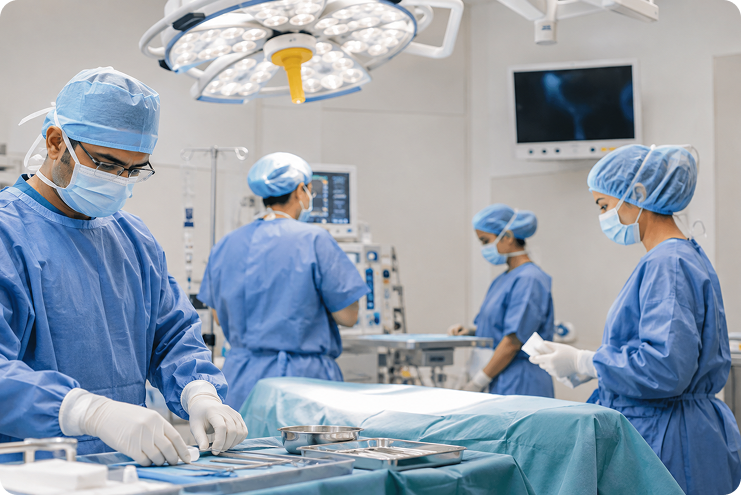
You’re asleep under general anaesthesia the whole time. A small tunnel is made through your back into the kidney, guided precisely by imaging. The stone is broken up and cleared out through that same tunnel. A small drainage tube may stay in for a short while afterward, just to help things heal.
Recovery
Getting Back on Your Feet
Most people spend a day or two in hospital, then ease back into normal life over one to two weeks, which is noticeably quicker than old-style open surgery.
Some soreness near the small incision is completely normal in the first few days.
Why This Instead of Something Less Invasive?
For a stone this size, PCNL usually clears it in one go, fewer repeat procedures than you’d typically need with shockwave treatment alone. Whether it’s the right call for your specific stone depends on its size, position, and shape, which is exactly what a consultation will confirm.
Not sure if your stone needs PCNL, or something gentler? A short consultation gives you a clear answer.
MBBS (Manipal); Msc(Surg) HUKM; FRCS(Uro) Glasgow; MBU Cert; Fellowship in Urology (QEH, Adelaide, S.Australia)
Dr Balan is a Consultant Urologist at Pantai Hospital Kuala Lumpur with over 12 years of specialist experience, holding the FRCS (Urology) from the Royal College of Surgeons, Glasgow, and advanced uro-oncology training from Queen Elizabeth Hospital, Adelaide.
He treats stone disease using the full range of modern surgical and non-surgical techniques, tailored to what’s actually right for your stone, not a one-size-fits-all approach.
If you’re experiencing symptoms of a kidney stone, or have already been diagnosed and want to understand your treatment options, book a consultation to discuss the right path forward.
Approachable, Compassionate, and Committed
delivering high-quality, patient-focused care.
Over 20 Years of Expert Surgical Care
Personalised, Compassionate Approach
State-of-the-Art Facilities at Pantai Hospital KL
Advanced & Modern Techniques used across Urological and Uro-Oncology Conditions