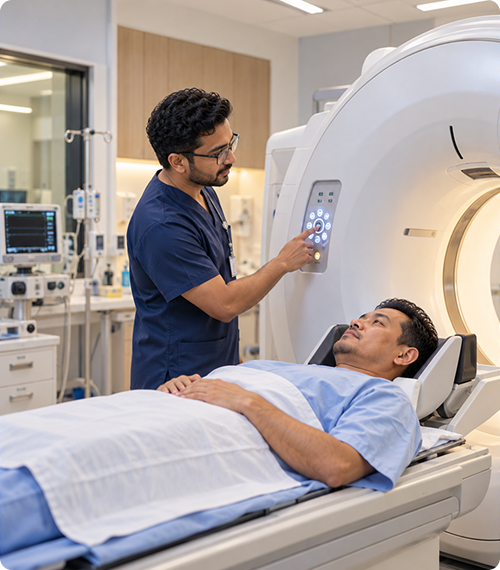
A kidney stone diagnosis isn’t just about confirming a stone exists — it’s about understanding its size, location, and composition, all of which shape the right treatment plan.
Here’s what the diagnostic process typically involves.
Your consultation begins with a review of your symptoms, medical history, and any risk factors — previous stones, family history, diet, and hydration habits all matter.
This context helps guide which imaging and tests are most useful.
A CT scan of the Kidney, Ureter, and Bladder. It shows the exact size, number, and position of stones, including smaller stones that ultrasound might miss.
This is often considered the most accurate way to confirm a stone diagnosis.
Step 3
Urine and Blood Tests
Urine Test
Can detect blood, signs of infection, and sometimes crystals that hint at what type of stone you’re forming.
Blood Tests
Check kidney function and calcium levels, which can point toward an underlying cause worth addressing to prevent future stones.
Step 4
Understanding the Stone
Not all stones are the same, and this matters for treatment planning.
Composition (calcium, uric acid, and other types) can influence prevention strategies going forward.
Your Treatment Plan
What Happens After Diagnosis
Once imaging confirms a stone and its characteristics are understood, Dr Balan will discuss which treatment approach fits your situation — whether that’s monitoring a small stone that’s likely to pass, or one of the active treatment options for a stone that needs intervention.
A non-invasive shockwave option for suitable smaller stones.
Learn more →
If You’ve Already Had a Scan Elsewhere
If you’ve had an ultrasound or CT scan done at another clinic or hospital and want a specialist opinion on your results and treatment options, you’re welcome to bring your existing imaging to your consultation.
This often means a faster path to a treatment decision without needing to repeat scans unnecessarily.
MBBS (Manipal); Msc(Surg) HUKM; FRCS(Uro) Glasgow; MBU Cert; Fellowship in Urology (QEH, Adelaide, S.Australia)
Dr Balan is a Consultant Urologist at Pantai Hospital Kuala Lumpur with over 12 years of specialist experience, holding the FRCS (Urology) from the Royal College of Surgeons, Glasgow, and advanced uro-oncology training from Queen Elizabeth Hospital, Adelaide.
He treats stone disease using the full range of modern surgical and non-surgical techniques, tailored to what’s actually right for your stone, not a one-size-fits-all approach.
If you’re experiencing symptoms of a kidney stone, or have already been diagnosed and want to understand your treatment options, book a consultation to discuss the right path forward.
Approachable, Compassionate, and Committed
delivering high-quality, patient-focused care.
Over 20 Years of Expert Surgical Care
Personalised, Compassionate Approach
State-of-the-Art Facilities at Pantai Hospital KL
Advanced & Modern Techniques used across Urological and Uro-Oncology Conditions